Personal project
Retail Plus
An internal social network for store teams.
A web application I designed and built on my own, based on problems I ran into in stores. It brings together a news feed for each store, tasks and checklists, business tools and a back office to manage permissions.
- Status
- In development
- Source code
- Private repository
- Technologies
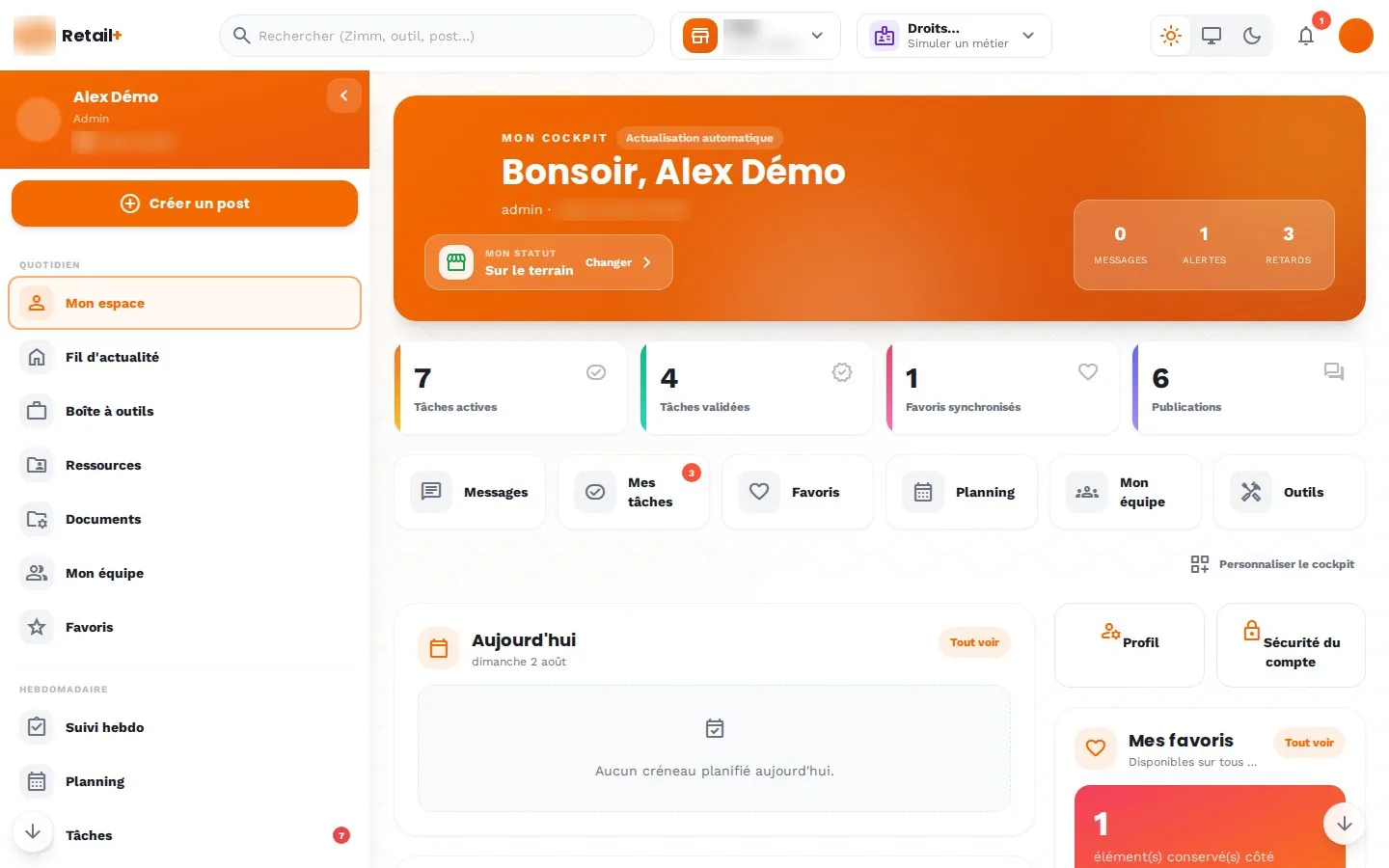
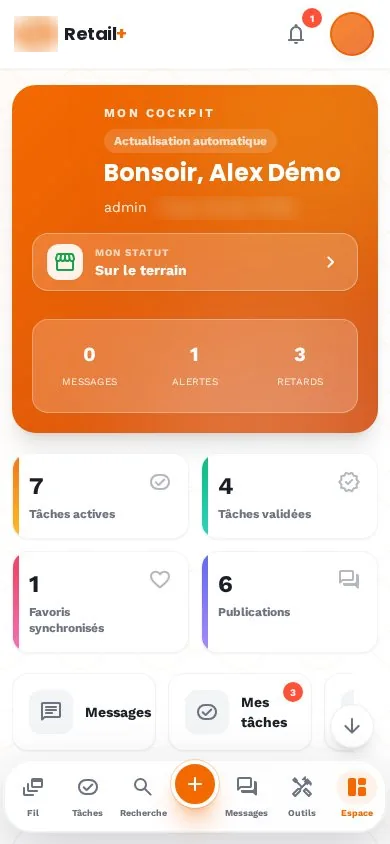
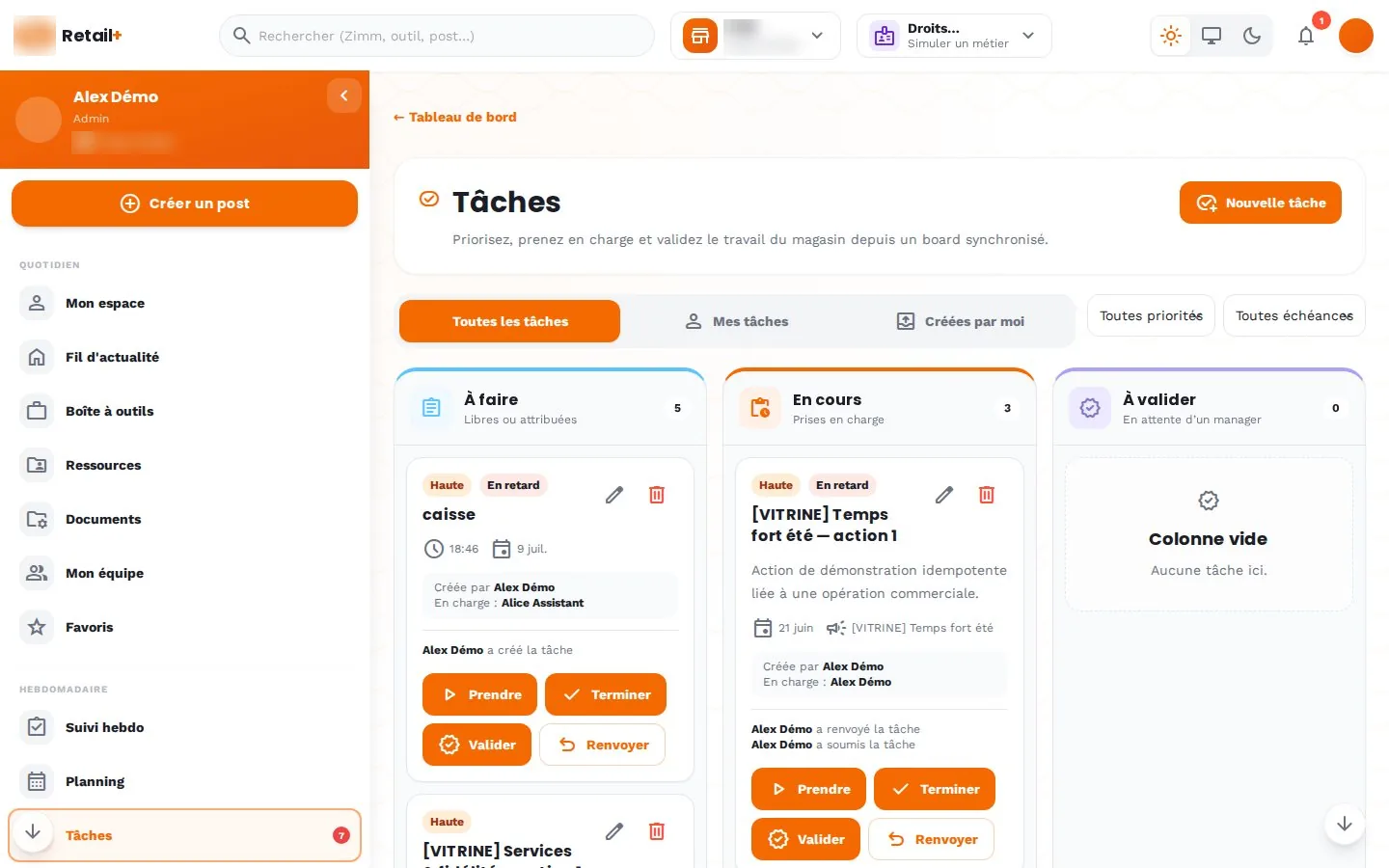
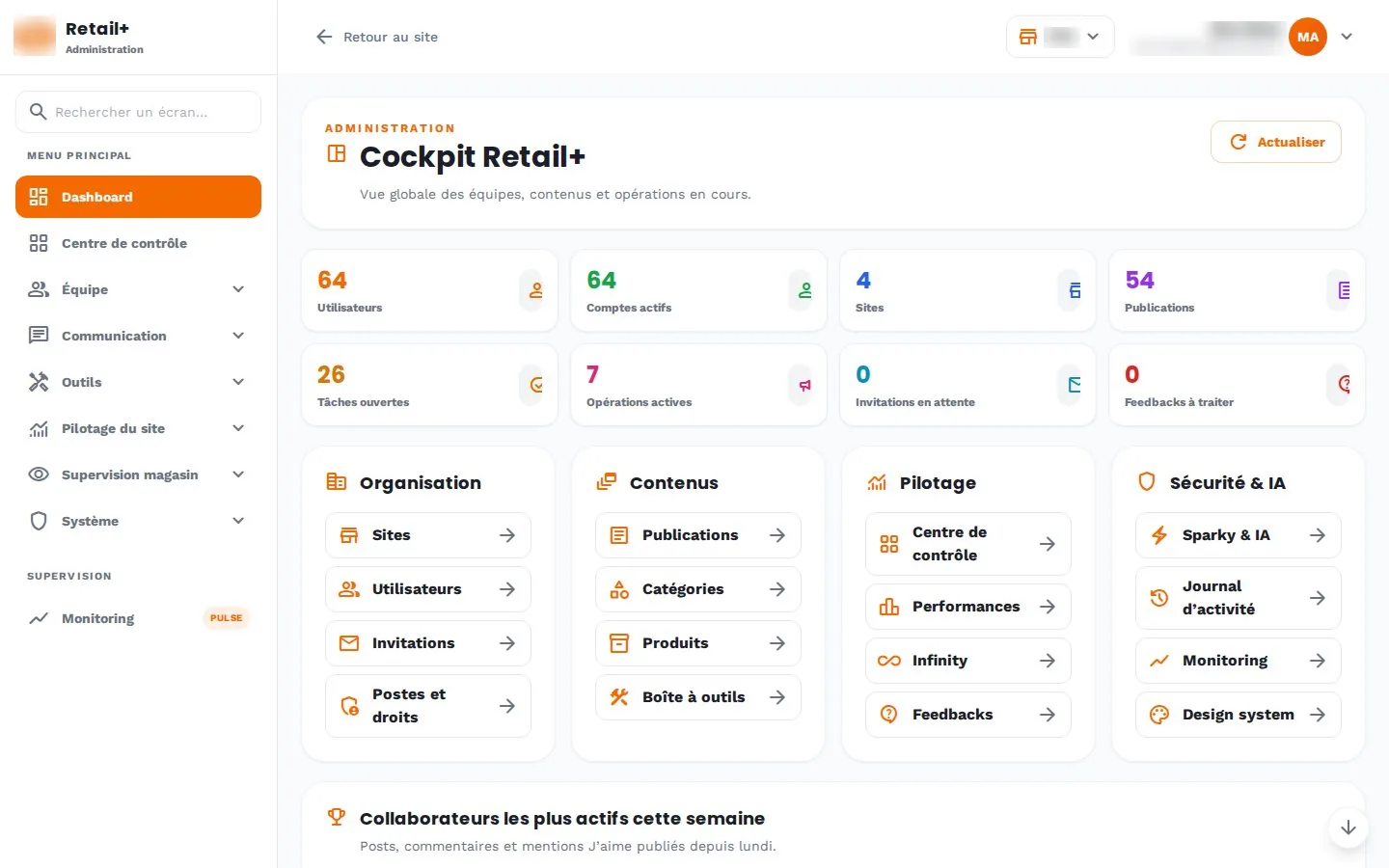
Screenshots from the demo environment (fictional data, company logo and store identifiers blurred).
My role and scope
Solo design and development, based on needs encountered in retail. Screenshots show a demo environment; no official company adoption or measured business outcome is claimed.
Architecture at a glance
React interface and Inertia navigation: the screens used by store teams.
Laravel: sessions, validation, store context and business rules.
Policies and permissions: actions authorised according to role and store.
MariaDB and Redis: relational data, caching and real time with Reverb.
Interface, business rules, data and real time: the project’s main layers.
Where it started
After years working in stores, I kept seeing the same problems: information scattered across several channels, instructions that were hard to find, tasks and checklists tracked by hand. Retail Plus is my technical answer to those problems, designed for the teams on the shop floor rather than for management.
What the application does
A news feed for each store
Categorised posts, comments, mentions and expiry dates. The feed distinguishes store content, regional posts and national communications.
Tasks and checklists
Real-time task board, assignment, manager validation, reusable templates and recurrences. Weekly checklists for each store.
Toolbox
QR code and barcode generators, returned-product tracking, guided diagnosis and a request form with PDF export.
Learning and documents
A catalogue of training modules and a searchable library of business documents.
Team and org chart
Directory, direct managers and an interactive org chart for each site.
Notifications and mobile
Push and real-time (WebSocket) notifications; a web app that can be installed on a phone (PWA).
Administration
Management of users, sites, content, job positions and permissions.
Design decisions
-
A Laravel monolith with React pages
Laravel keeps sessions, CSRF protection, permissions, validation and business logic. Inertia only replaces navigation and page rendering for signed-in users, so I don't have to duplicate logic in a separate API.
-
An authenticated JSON API
Sanctum-protected routes expose business data. Controllers use form requests, policies and JSON resources; interactive screens can consume that data without reloading the entire page.
-
Store context and explicit data scopes
The active store is determined on the server. Eloquent scopes and policies constrain queries and actions according to the resource. The feed also supports national and regional posts, distinct from store-specific data.
-
Layered permissions
System role, configurable job position and functional permissions (Spatie Permission), with individual exceptions when needed. Checks rely on policies and form requests; rich content is sanitised with HTMLPurifier.
-
An interactive org chart with React Flow
React Flow displays relationships between team members. Assignment logic stays in a Laravel service: same-store membership, active accounts, authorisation and cycle prevention are checked on the server.
-
Transactional hierarchy changes
Moving a team member runs inside a database transaction with locking. Assignments are read again before modification, history is retained and an update event is emitted after the transaction.
The main trade-off
Laravel keeps business logic and web sessions, while Inertia serves React pages. Sanctum-protected JSON routes complement navigation for business interactions and mobile sessions. Access rules remain on the server regardless of the client.
Real problems, technical answers
-
One store must not see another store's content.
Store context, query scopes and policies; regional and national sharing remain explicit.
-
Each job needs different permissions, without touching the code.
Positions and permissions configurable from the back office, with individual exceptions.
-
A team hierarchy has to stay consistent.
Server-side validation: no cycles, no inactive accounts, no links between sites.
-
Teams need to be notified without reloading the page.
Laravel Reverb for real time and push notifications on mobile.
Technologies
- Laravel 13
- PHP 8.5
- React 19
- Inertia 3
- Tailwind CSS 3
- MariaDB
- Redis
- Laravel Reverb
- Spatie Permission
- React Flow
- PWA
Test scenarios present in the project
- Tasks: assignment within the same store, cross-store access rejection, permission-based submission and approval, then creation of the next occurrence.
- Hierarchy: cycle rejection, mutations scoped to the authorised store and bounded history without email addresses.
- Rich content and interface: HTML sanitisation, React component tests and navigation checks.
These scenarios are versioned in the repository. No coverage percentage or load-test result is claimed here.
Next steps
Extend regression testing for permissions, hierarchy changes and recurrences, then measure real-time and queued-processing behaviour under load. These measurements are not presented as already completed.
Good to know
Retail Plus is a personal project. It is neither officially adopted nor deployed by Boulanger. The repository is private and the code is not published. The screenshots come from a demo environment with fictional data; the company logo and store identifiers are blurred.